C2PA and watermarks: differences, limitations and when to combine them
Compare C2PA, visible and invisible watermarks, fingerprints and hashes: what they check, how they can work together and what a pilot should test.

C2PA and watermarks are not synonyms. A watermark can make a signal in the content recognizable; C2PA organizes signed, verifiable provenance claims. Some systems can use both, but they answer different questions.
If you distribute photographs or corporate content, begin with your objective: do you want to display a brand, recover a reference after a transformation, or let a reader inspect provenance claims? This distinction prevents you from choosing a technology while expecting guarantees it does not provide.
What a visible watermark is
A visible watermark is an element placed over an image, such as text or a logo. It forms part of what the user sees and can signal the declared origin of that copy.
The mark does not authenticate itself. A branded image may have been copied, modified, or published in another context. A watermark can aid recognition, but it is not equivalent to a cryptographic check of the issuer and the version.
A simple example is a photo used as a catalog preview. The logo helps identify the channel offering it; verifying a delivery still requires a file reference and an understandable distribution process. Rights management also remains separate from the presence of the mark.
Invisible watermarks and fingerprints are different
An invisible watermark embeds a signal in the content that compatible tools can read. A perceptual fingerprint instead derives features used to look for a match among similar content. Their robustness depends on the algorithm and the transformations applied; it cannot be assumed.
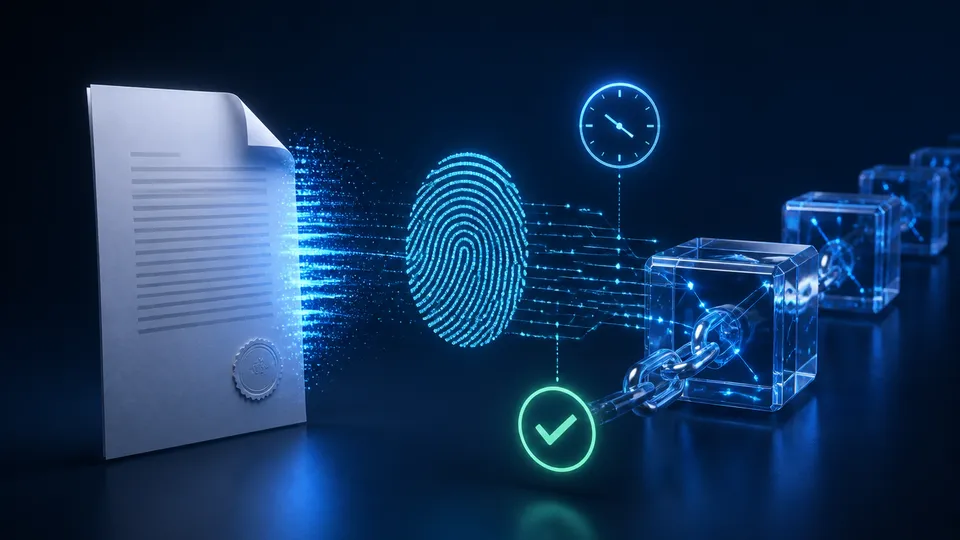
Neither should be confused with a cryptographic file hash. SHA-256 compares a precise sequence of bytes. A perceptual recognition system may look for a relationship after some bytes have changed, according to criteria that must be made explicit.
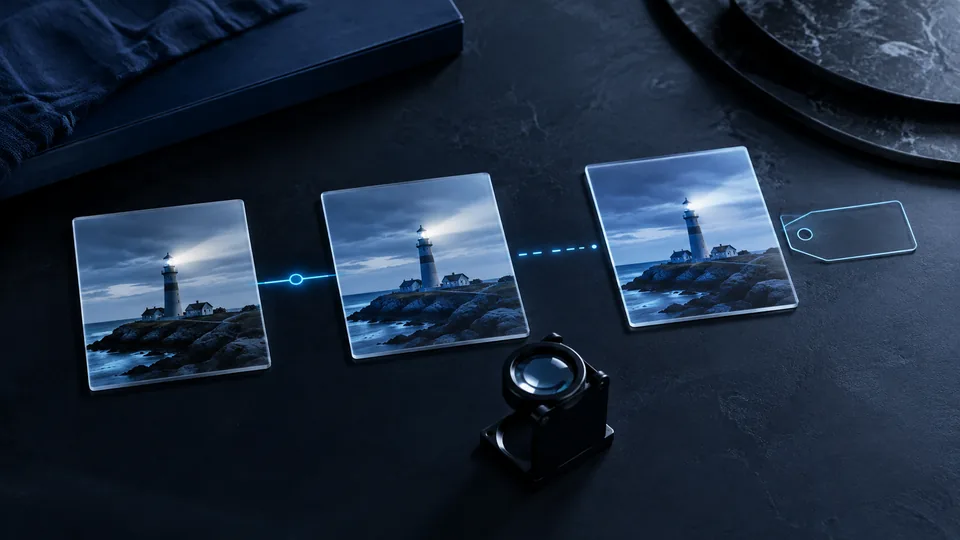
This difference matters when an image is resized. The new file may no longer have the same hash as the original while remaining recognizable to a particular perceptual system. Recognition does not justify the conclusion that every detail is unchanged.
What Content Credentials add
Content Credentials let people read claims associated with an asset and the results of checks defined by C2PA. Verification considers the binding to the content, the signature, and the selected trust model.
For a reader, the value is not simply finding “something similar,” but understanding which information is available for that version. This can include declared actions, ingredients, or production details. Missing information should not be invented, and a valid signature does not automatically make a scene true.
For an explanation of manifests and signatures, see the introductory C2PA guide. Here the goal is to compare functions, not to declare one mechanism always better than the others.
Comparison: which question does each tool address?
| Tool | Question it can help answer | What not to assume |
|---|---|---|
| Visible watermark | Which mark accompanies this image? | That the mark proves the identity of whoever applied it |
| Invisible watermark | Is a signal readable by the compatible system present? | That every transformation preserves it |
| Perceptual fingerprint | Does this content match a reference under a similarity criterion? | That the files are identical byte for byte |
| Cryptographic hash | Does the file match a trusted reference fingerprint? | That the hash tells us who created it |
| C2PA credential | Which signed claims can be verified for the asset? | That provenance proves the truth of the whole story |
The table is a design aid. In practice, check the features of the specific implementation, its supported formats, and what its results mean.
How watermarks and C2PA can work together
The C2PA specification on soft bindings includes bindings based, for example, on watermarks or fingerprints. These mechanisms can help recover credentials when an embedded binding is no longer available.
Retrieving a candidate credential and validating it are separate steps. A system should not present a simple match as though every check on the current copy had passed. The C2PA Soft Binding API document describes a reference architecture; it does not mean every verifier implements it.
For SCE, as for any product, the actual features available must be checked. This guide does not claim that the public verifier can retrieve any credential from a watermark or screenshot.
Run a pilot before choosing
Prepare a small set of representative assets: a photo with fine details, an image with uniform areas, and content containing text. Define the transformations that really occur in your channels instead of selecting only easy tests.
Keep the original and result for each version. Record separately whether the mark remains visible, the signal is recognized, the credential is found, and the checks are completed. Do not compress everything into a single “works” label.
Testing the file downloaded from the public website is particularly useful because it may differ from the file held in the CMS. The credentials not found guide helps you handle these results without rushing to conclude that the content is fake.
Frequently asked questions
Is a watermark enough to identify AI images?
Not in general. You need to know which system applies it, how it detects it, and which files carry it. The absence of a signal does not prove that an image is a photograph.
Does C2PA prevent someone from copying an image?
No. It is a provenance system, not a copy-prevention mechanism. Distribution and any access controls must be designed separately.
Must I choose only one approach?
No. You can combine them if each has a defined purpose and their results remain distinguishable. A good design tells the reader what was recognized and what was actually verified.
Sources and further reading
Technical and editorial references consulted for this guide. Examples are illustrative and do not document real cases or specific integrations.