How to verify news sources: from the headline to the evidence
Assess news sources through lateral reading, original documents and independent evidence, with a practical example and an evidence record.
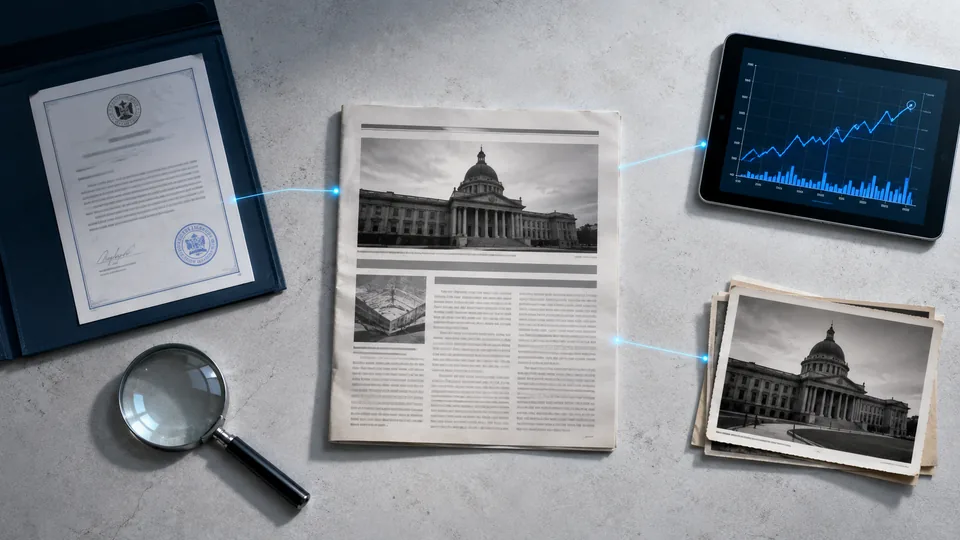
To verify the sources of a news story, look beyond the website's appearance or the name of the person sharing the link. Reconstruct the path from claim to evidence: who gathered the information, which document supports it, and which independent checks are available.
This guide focuses on that path. It is useful when an article cites a report, statement, or supposed official announcement and you want to know whether the reference actually supports the headline.
Start from a checkable claim
Write the fact to be checked in one line, preserving the subject, action, date, and scope. “The organization changed all its hours” differs from “one location changed its Saturday opening time.” Seeking confirmation of the first sentence using evidence for the second produces the wrong conclusion even if the document is authentic.
If the text contains a forecast or opinion, separate it from the facts used to support it. A judgment cannot be treated as an observed measurement. You can instead check whether the cited data exists and whether it was interpreted correctly.
Keep the link and date of your check. The question is not only what appears on the page today, but which version you viewed when assessing the claim.
Leave the website to understand who is behind it
The Digital Inquiry Group describes lateral reading as checking a source through what other digital sources reveal about it. Instead of reading only how a website presents itself, open separate searches for the author and organization.
Confirm that the name belongs to the right person or organization. Look for relevant expertise, editorial responsibility, and identifiable contact details. Do not confuse people with the same name, demo pages, personal profiles, and institutional channels.
An elegant layout can belong to a weak source; a simple page can contain an important document. Design aids reading, but it does not prove how the information was gathered.
Trace the document, not just the citation
Open the references in the article and find the exact passage that is supposed to support the sentence. If a link leads to a home page or document that does not contain the claim, the check is incomplete.
For a statement, find the recording or complete text. For a report, at least check who produced it, the period covered, and its scope. A primary source is close to the original event or data, but it can still contain errors, limitations, or interests: “primary” does not mean “infallible.”
In its fact-checking method, AFP explicitly describes the use of primary material and cross-checking. Here we propose a practical record that makes your verification path visible without presenting it as an already completed professional investigation.
Build a small evidence record
Imagine a wholly hypothetical article claiming that a museum canceled every guided tour. The available references are a flyer, a notice from the museum, and a blog repeating the notice.
| Item collected | What it lets you check | What is missing |
|---|---|---|
| Undated flyer | The text circulating in the chat | The flyer's version, date, and provenance |
| Notice on the museum website | The announced change for one specific day | Any later announcements |
| Blog citing that notice | How the message was repeated | Independent evidence about other days |
The record does not score websites. It connects each piece of evidence to the question. If the notice concerns only one morning, it does not support the cancellation of all tours.
You can add a column for the exact passage and another for the date accessed. In group work, this structure lets a colleague quickly see what has already been checked and what still needs verification.
Distinguish independent evidence from copies
When several articles use the same words, check whether they cite a common source. A press release republished by three sites remains one press release: the copies may help trace its circulation, but they do not add three independent observations.
Independent evidence should contribute a distinct, relevant element. It might be a complete recording, a separately produced document, or verified testimony. A different domain is not enough; the path by which the information was obtained must differ.
Do not adopt a mechanical rule that “two links make the story true.” Even two independent sources may cover different aspects. The relationship between the evidence and the claim should guide the conclusion.
Write a proportionate conclusion
Conclude by stating what you established and its limits. In the museum example: “The notice confirms a suspension that morning; it does not support a general cancellation.” This is more precise than one label applied to every element of the post.
If sources conflict, identify the point of disagreement and check whether one is later than the other. State when you cannot resolve the doubt. An AI assistant can help organize notes, but a generated summary does not replace opening the documents it is supposed to cite.
To turn this method into a habit before sharing, use the fake-news prevention checklist. For an attachment, distinguish reading its content from checking the PDF's integrity; the second does not by itself prove that its claims are correct.
Frequently asked questions
Is an official website enough to confirm any claim?
No. It is an important reference for what the organization communicates, but the statement's scope must be checked. A notice about one service does not automatically prove every interpretation others draw from it.
Does an archived page prove that an event happened?
It documents what appeared in the retained copy, not necessarily the truth of the account. Keep the existence of the publication separate from the existence of the event.
If the source contains a photo, should I verify that too?
Yes, if the conclusion depends on the photograph. Follow the process for images taken out of context, comparing its use with the stated date and event.
Sources and further reading
Technical and editorial references consulted for this guide. Examples are illustrative and do not document real cases or specific integrations.